Posted on February 26, 2026


This article has been superseded by Understanding the EU Pharma Package and how to prepare for its implementation in 2028.
After several years of negotiations between the European Commission, Parliament and Council, the European Union is on the verge of implementing the most significant reform of its pharmaceutical regulatory framework in more than two decades. On 11 December 2025, provisional agreement was reached on the new “EU Pharma Package”, a comprehensive overhaul that will reshape how medicines are developed, authorised, protected, and commercialised across the EU. In particular, the EU Incentives Review aims to address better patient access to medicines, increasing innovation in areas of unmet need and reducing shortages of medicine.
The new Legislation is expected to be formally adopted in Q2 2026, with most provisions applying from mid‑2028, following a two‑year transition period. We do not yet have the final text, as we are awaiting publication of the General Pharmaceutical Legislation to see what has been agreed. What we do know is that the final version of the Directive will focus on adapting the current Exclusivity periods more towards unmet needs, the calculations of which will be more complex, incentivising launch of new antibiotic products and focussing on facilitating drug supply in EU member states. This is what we know so far.
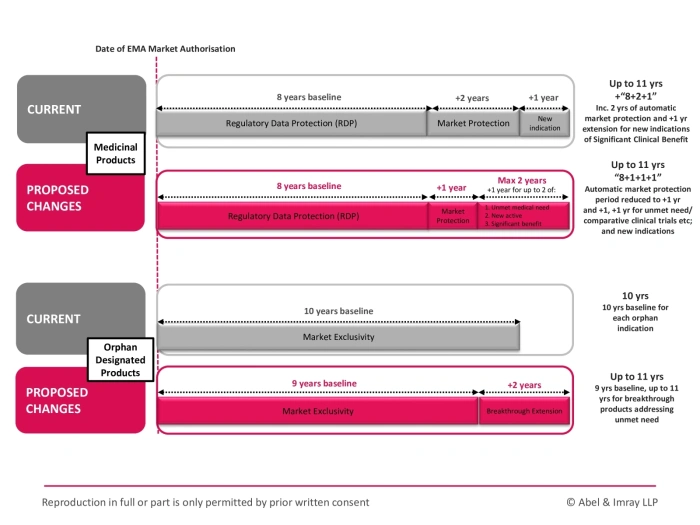
You can view our 'EU Pharma Package Overview Chart' at the end of this article or download it using the Download button on the right-hand side.
What Is the EU Pharma Package?
The EU Pharma Package will consist of a new EU Regulation and a new EU Directive that will replace several core Legal Instruments governing medicinal products, including the current EU Directive 2001/83/EC, Regulation (EC) No. 726/2004, the Orphan Regulation (EC) No. 141/2000 and the Paediatric Regulation (EC) No. 1901/2006. In short, it means major changes for the Regulatory Exclusivity (Data and Market) protection of pharmaceuticals, in particular. The biggest question is how the current rules compare with the proposed new ones. Below is an overview of the most likely major changes.
Regulatory Exclusivity
One of the most consequential aspects of the EU Pharma Package is the complete re-design of the Regulatory Exclusivity framework, replacing the long‑established “8+2(+1)” year term for Regulatory Data and Market Protection (RDP).
Under current rules, new medicinal products benefit from 8 years of Regulatory Data Exclusivity. During this period, a generic or biosimilar company cannot rely on the originator’s clinical and pre‑clinical data to obtain Marketing Authorisation for its generic or biosimilar product. This 8 years of baseline data protection is likely to remain.
However, the two-year (+2) period of Market Exclusivity, which currently automatically follows the Regulatory Data Exclusivity period, will most likely be reduced to a one-year (+1) period under the new proposals. During this period, generics and biosimilars can make preparations for approval of their products relying on the Originator’s data to demonstrate safety and efficacy but they cannot launch their products until the end of this Market Exclusivity period.
It is currently possible to obtain an additional one-year (+1) period of Market Exclusivity for an indication of “Significant Clinical Benefit”, however, under the new proposal, the 8-year period of Regulatory Data Exclusivity and (+1) year of Market Exclusivity is proposed to be extended by 1 additional year for each of the following conditions, up to a maximum combined Exclusivity period of 11 years:
- addressing an unmet medical need (+1 year);
- meeting certain conditions, such as comparative clinical trials (+1 year);
- adding new indications that offer “Significant clinical benefit” (+1 year).
These changes are aimed at incentivising research and development into rare and ultra-rare diseases, and to reward research into products that address an unmet or a high unmet clinical need. However, what is not yet clear, is how these criteria will be applied in practice. It does appear that the Exclusivity protection periods are likely to become shorter, more complex and more nuanced for the majority of molecules. It is also likely that more data will be needed to achieve the maximum protection available.
Orphan Medicines
For an Orphan designation, the current framework provides for 10 years of Market Exclusivity per Orphan indication. This period may be extended by 2 years where a Paediatric Investigation Plan (PIP) has been completed. This period exists in parallel with RDP.
This baseline protection for “Regular” Orphan medicinal products under the new proposals will be reduced to 9 years of Market Exclusivity.
However, a new “Breakthrough” category of Orphan medicinal products will be introduced for medicines addressing high unmet need. This category includes products for diseases with no available EU treatment where strong evidence of clinical benefit is shown. Under the new proposals, the baseline protection for Breakthrough products will be 11 years of Market exclusivity. Such extensions will need to show evidence of clinically relevant reduction in disease morbidity or mortality for the relevant patient population.
The proposal of a new “Global Orphan Marketing Authorisation” Concept is expected to become part of the new Legislation. The intention is to prevent “evergreening” of the same active ingredient where an MA holder holds more than one MA for the same active substance. Orphan Market Exclusivity is expected to be extended by a one-year (+1) period for each new Orphan therapeutic indication to a maximum of +2 years rather than the current situation of 10 years of Market Exclusivity per indication running in parallel.
Paediatric Exclusivity
The reward of 6-month extension to an SPC will remain, following completion of a PIP linked to the first approved indication.
It is also currently possible to obtain an additional year (+1) of Market Exclusivity for a new indication of “Significant Clinical Benefit” under RDP, paediatric conditions being one type of condition falling under the definition of “Significant Clinical Benefit”.
It should be noted that there can be no double rewards for the same paediatric indication i.e. one must choose an extension to the SPC or to the RDP. This provision is also expected to remain.
The current 2-year (+2) reward for a paediatric indication with regard to Orphan Products will, however, no longer be available under the new proposals.
AMR – Anti-microbial Resistance
There is a new incentive for launching new antimicrobial products. This takes the form of a “Transferable Data Exclusivity Voucher” for priority antimicrobial products. This will give an additional year (+1) of data protection for one authorised product. The additional year of data protection may be used once, for the priority antimicrobial or for another centrally authorised medicinal product of the same or a different MA holder.
However, it is not certain how many of these vouchers may be awarded nor if additional requirements will be required to obtain a voucher.
Expanded Bolar Exemption
The Bolar exemption is a legal provision in that allows clinical trials and other launch preparations, for generic and biosimilar medicines to be carried out before the expiry of a patent or a Supplementary Protection certificate (SPC), without this being considered patent infringement.
To date, Article 85 of the EU Directive 2001/83/EC has only covered clinical trials and studies strictly necessary for marketing authorisation, although it has been implemented more broadly when adopted into the national laws in numerous European countries to also include clinical trials and other launch preparations for innovators.
The EU Pharma incentives review includes comprehensive reform proposals aimed at improving access to affordable medicines and reducing legal uncertainties. A key element is the revision of the Bolar Exemption through Article 85 of the proposed EU Directive.
These reforms appear to be aimed at making it easier for generic and biosimilar manufacturers to be ‘launch-ready’ once the patent or the Supplementary Protection Certificate (SPC) expires.
The main changes are likely to be beneficial to generic and biosimilar companies as follows:-
- Clearer Definitions: Article 85 of the EU Directive provides explicit guidance on permissible activities under the exemption, including those necessary for approval processes, health technology assessments (HTAs) and pricing procedures;
- Expanded Scope: The revised rules broaden the exemption to cover activities such as manufacturing, storage and import by 3rd party providers, which were previously ambiguous; and
- Harmonization: By addressing inconsistencies in national implementations (caused by different EU countries having different wording for the Bolar exemption written into their law), the proposal seeks to reduce legal uncertainty and streamline processes across the EU.
Supplementary Protection Certificates (SPCs)
Although EP patents with Unitary Effect have been available since June 2023, SPCs continue to be available solely at national level.
The current SPC system is inefficient and costly, thereby creating legal uncertainty.
The Proposal for a Unitary SPC is part of the EU Pharma Package, and it aims to simplify the EU’S SPC system and improve its transparency and efficiency by creating a new centralised examination procedure. However, there appears to have been little movement on this.
Our take
Whilst the final legislative text hasn’t been released, the changes announced so far will allow quicker and more coordinated generic entry into the market, with reduced periods of protection in terms of RDP, paediatric extensions and Orphan market exclusivity for innovators. In particular, the expansion of the Bolar exemption allows for generics to hit the market the moment patent protection expires.
Extensions of the baseline Regulatory Exclusivity periods are going to available but are likely to be more difficult to achieve in practice. We are also likely to see much more uncertainty regarding whether an extension may be granted, given the increased need to demonstrate clinical effectiveness or an unmet need. Such protection is less important where primary protection for a product is provided by one or more patents which outlast the Regulatory Data Exclusivity, but it may be relevant where it is intended to rely on other types of exclusivities as the primary protection for a product.
Overall, innovators will need stronger and more robust patent portfolios, and more careful planning will be necessary, to retain their competitive edge against increasingly well-prepared generic competitors.
If you would like guidance on strengthening your IP position, navigating the new framework, or assessing how these reforms affect your portfolio, our team at Abel + Imray is here to help. Many of our attorneys have worked in‑house within the pharmaceutical industry, so we can provide practical, experience‑led advice tailored to your needs. For more information, please contact Chris Lindsay, Lindsey Kent, or your usual Abel + Imray advisor.