- Home
- Resources
- Newsletters
- CRISPR and...
CRISPR and Machine Learning: What Does the Patent Landscape Show?
Posted on July 08, 2026

Since its discovery, CRISPR has transformed genome editing, giving researchers a much more precise and efficient way to modify DNA. More recently, machine learning (ML) has started to play a growing role in CRISPR research. Researchers now use ML in a range of CRISPR applications, from predicting guide RNA performance to identifying potential therapeutic targets from large biological datasets. As these computational tools become more closely integrated with experimental workflows, an important question comes up: "are innovators already seeking patent protection for ML-related CRISPR technologies?"
The simple answer is yes.
A review of publicly available patent data suggests that filing activity at the intersection of CRISPR and ML is already underway, particularly in the United States. For innovators developing CRISPR-based technologies, this offers an early sign of where future innovation may be heading.
Why does machine learning matter for CRISPR?
CRISPR experiments generate a lot of data. Screens can test thousands of genes at once, often across different cell types or disease models, and phenotypic readouts can be quantified. Earlier steps in the CRISPR workflow, including guide RNA selection, also rely on large datasets built from past experiments. That makes ML useful because it can pick out patterns, predict what is most likely to work, and help researchers focus on the most promising next steps.
Guide RNA design is a clear example. Selecting guides that hit the right target while minimising off-target effects has traditionally involved a lot of trial and error. ML models can now predict guide performance before a screen begins, saving time and cost. This approach is already reflected in patent filings, with companies such as Philips, The Broad Institute and the Regents of the University of California, among others, having obtained granted patents to AI-based CRISPR methods. These include, for example, the use of ML models to determine the presence of antimicrobial resistance genes, and to identify suitable target sequences for CRISPR-based therapeutics.
ML is also useful for target identification and prioritisation. CRISPR screens can assess thousands of genes simultaneously but often produce complex and multi-dimensional datasets, especially when CRISPR is combined with other sources of information, such as single-cell sequencing, imaging, or proteomics. ML can help find patterns across datasets, predict gene interactions, and identify key pathways. This is especially valuable in areas like oncology, where the biology is complex and context-dependent. Again, this is already reflected in patent activity, with one filing by Nobel Laureate Jennifer Doudna (US12286623) covering methods and kits for identifying cancer treatment targets using a CRISPR screen followed by ML analysis. It is clear that ML techniques have only accelerated research into this ever-growing area of therapeutics.
What does the patent landscape show?
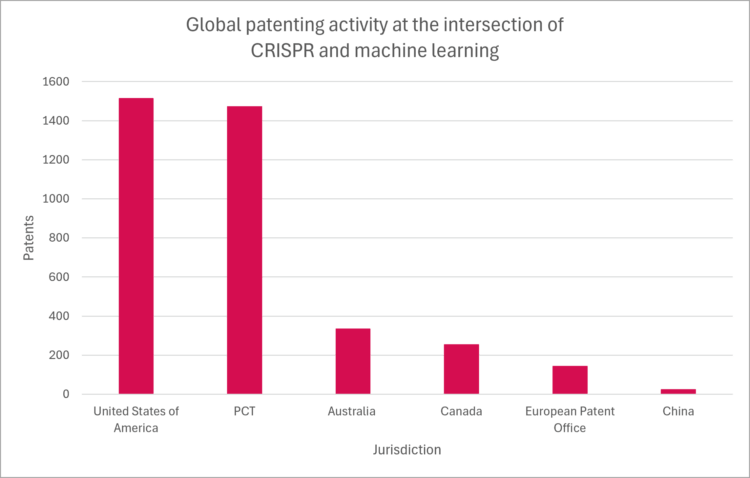
This growing use of ML in CRISPR-based research is starting to show up clearly in patent filings. Filing data (obtained from WIPO - PATENTSCOPE) shows a large number of patent families now sit at the overlap between CRISPR and ML. One clear trend is these filings are predominantly made in the United States. For example, about 1,500 patents were identified in the US compared with roughly 140 in Europe. That is likely a result of the USPTO’s generally more liberal approach to ML methods when compared to that of the EPO for example. However, the high number of PCT filings suggest that applicants do see a value in pursuing patent protection outside of the US alone.
The filings in this area cover a wide range of work, including guide RNA prediction, analysis of CRISPR-generated datasets, identification of multidrug-resistant gene targets in infectious bacterial samples, and ML-assisted target discovery. Taken together, they suggest that ML is increasingly part of the inventive concept itself, not just used as a background research tool. This suggests a shift from ML as a research tool to ML as a core component of the invention itself. This also shows that biotech companies are increasingly seeing the value in protecting their AI-methods themselves, as opposed to relying on, for example, trade secret protection.
What could this mean for IP strategy?
For innovators developing CRISPR-based technologies, the overlap between ML and gene editing raises several important considerations for their IP strategy.
First, for those employing ML or AI based models in their work, it is worth considering protecting the method used, as well as the output of the models as such. Some aspects of this may give rise to patentable subject-matter which should be considered as part of any IP strategy. The overall value of such an innovator’s IP portfolio may sit not just in the biological discovery, but also in the ML model itself, or a combination of both.
Second, the use of ML can accelerate research and development by enabling earlier identification of promising targets or therapeutics. This can put innovators in the position of having to decide whether to pursue patent protection earlier, and before biological data may be available. Applicants are increasingly using in silico data to justify patent filings made at an earlier stage.
Finally, high-quality datasets may become valuable commercial assets in their own right. Many ML models depend on access to strong training data, which may have been generated in-house. These kinds of proprietary datasets can provide a real advantage over competitors. Likewise, information about which targets do not work, although not an invention, can be highly commercially sensitive. Some consideration as to how to protect these datasets is an essential part of any IP strategy, which should include a formal trade secret policy, particularly where patent protection may be difficult to obtain.
Looking Ahead
The relationship between CRISPR and ML is likely to become increasingly important as both technologies continue to develop. A review of the patent landscape suggests that ML is already becoming part of CRISPR-based innovations, with applications being filed on everything from guide RNA design and selection to target identification and data analysis.
As ML becomes more deeply embedded in CRISPR workflows, it is likely to play an increasingly central role in defining both the technical and commercial value of these types of inventions. This is an area worth watching closely and we certainly will be.
If you would like guidance on strengthening your IP position, navigating the nuances of patents covering ML or AI, or assessing how best to protect your portfolio, our team at Abel + Imray is here to help. Many of our attorneys have worked in‑house within the pharmaceutical industry, so we can provide practical, experience-led advice tailored to your needs.
For more information, please contact Isabel Leitch, Chris Lindsay, or your usual Abel + Imray advisor.
